✦ about ✦
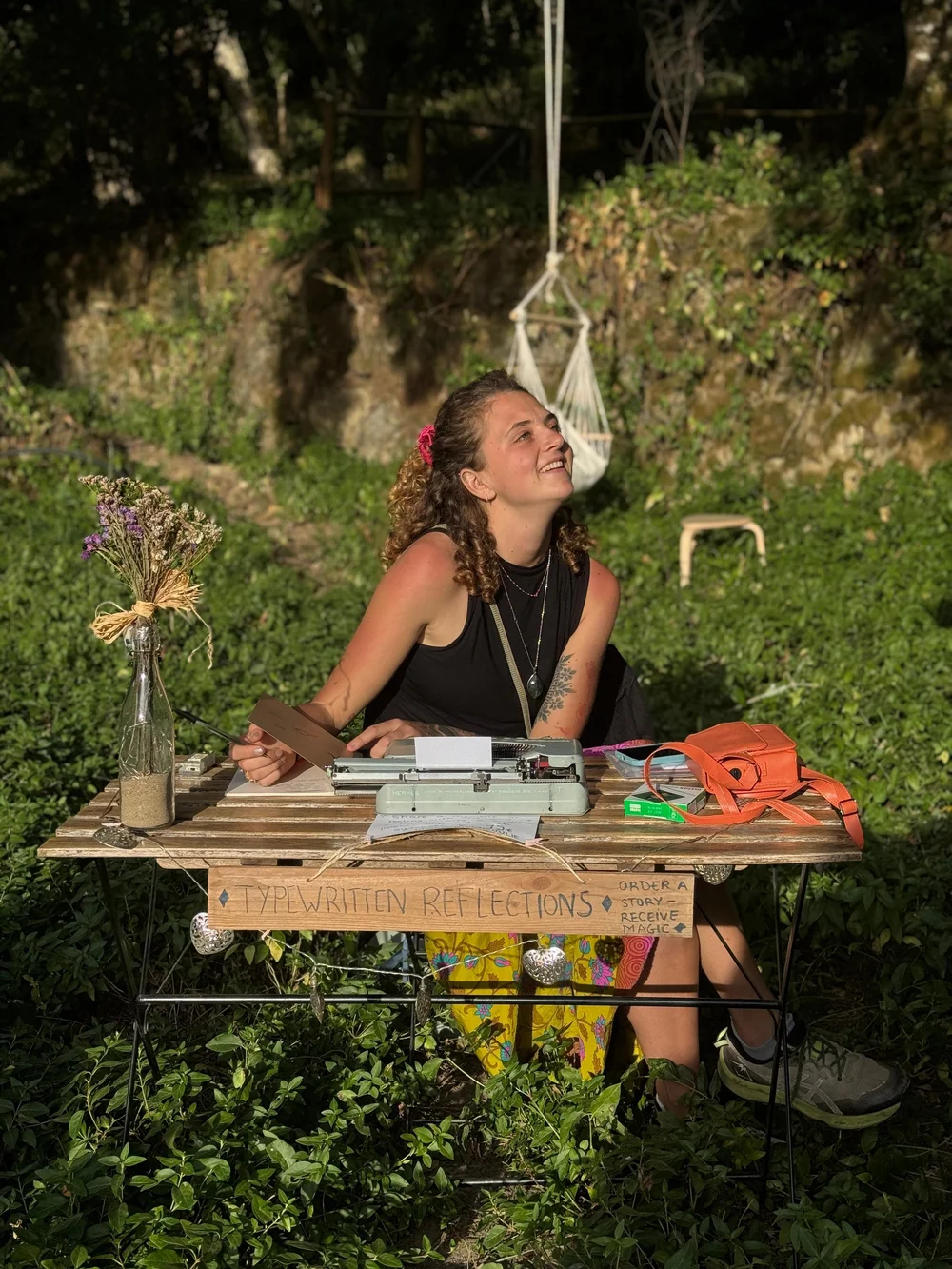
Hi, I’m Julie.
For years I lived inside a story that wasn’t true. Changing it changed my life.
Now I listen to people, then write their story back to them as fiction.
You tell me something true. I write it back to you as fiction, so you can see it from the outside.
It’s not advice, and it’s not fixing. It’s a mirror.
✦ a few true things ✦
Notes from my desk
For years I felt like too much, and somehow never enough. Then I saw it was a story I kept telling myself, and that story was what kept me stuck.
I left Monaco with a backpack and spent ten years moving through the world.
I studied management to do something sensible. Then I found myself in an MLA in Creative Writing at Harvard Extension School.
I love humans. I love seeing the world from someone else's side. Truth is relative, and every new perspective shows me a little more of it.
The only constant is change. Stories and life are tied together: change the story you tell, and your life can change with it.
✦ what I believe ✦
I believe story is the most important thing in life.
Before we act, we narrate. Before we choose, we have already told ourselves a story about who we are and what is possible for us. Most of us never examine that story. We inherit it — from childhood, from fear, from the quiet accumulation of other people's opinions — and we live inside it as though it were reality rather than a draft.
It is always a draft.
i. the story I lived inside
I know this because I lived for years inside a story that was not true. Anxiety is a masterful author. It writes with such conviction, such detail, such internal logic, that you forget you are reading fiction. I forgot. For a long time I forgot.
ii. the backpack
Then I left Monaco with a backpack and spent ten years moving through the world. I sat with people whose lives were entirely unlike mine. I saw how differently the same moment could be interpreted, how many versions of a life were available, how much depended not on circumstance but on the story being told about it. I began, slowly, to rewrite mine.
That is what story does. It is not decoration placed on top of a life already lived. It is the structure underneath. Change the story and you change the life. Not because the facts change — but because you do.
iii. why I write for other people
Not to entertain, though a good story always does. Not to distract, though sometimes we need that too. But to give someone a mirror that shows them something true — a child who sees their fear transformed into courage, a person crossing a birthday threshold who finally understands what their year meant, a stranger who gave me three words and received back a world they did not know they were carrying.
my promise: to hold up a mirror ✦
I don't just write your story. I receive it.
Something happens in the space between reading what you've sent me and writing the first word. I'll be sitting with a name, a feeling, a handful of details — and something arrives that I didn't plan. A story that seems to know more about you than I do.
I've always been this way. I read people the way others read rooms — I walk in and I feel what's there. It just comes through, and I've learned to follow it rather than question it.
I'm the one who types every word. But I've learned to follow what arrives, call it intuition or empathy. Every life has a myth in it, waiting to be told.
If you've ever felt that a story was waiting for you, you're probably right.
This is where you come to find it.
✦ why stories work ✦
Not a metaphor, a method.
Holding up a mirror isn't mysticism, and it isn't my invention. It's what the research on narrative has been describing for forty years. Here is what the work is built on.
“We tell ourselves stories in order to live.”
01
You already live inside a story.
The psychologist Dan McAdams calls it narrative identity: we arrange our experiences into an inner story about who we are, and that story shapes what we notice, choose and repeat.
Dan McAdams, The Stories We Live By (1993)
02
A story can be re-authored.
Narrative therapy, built by Michael White and David Epston, rests on one move: separate the person from the story they've been living inside. The person is not the problem; the problem is the problem. A stuck story is a draft, and drafts get rewritten.
White & Epston, Narrative Means to Therapeutic Ends (1990)
03
Putting it into words gives it a shape.
James Pennebaker's expressive-writing studies found that writing honestly about a difficult experience helps people make sense of it. Words force a shape onto something that had none. That's why every story begins with you telling me something true.
Pennebaker & Beall (1986); Pennebaker (1997)
Further reading: Jerome Bruner, ‘Life as Narrative’ (1987) · Timothy Wilson, Redirect (2011) · Ethan Kross, Chatter (2021)
Mot Vivant is fiction, not therapy. The research describes how stories shape us, not a promise of what one story will do.
✦ the practical bits ✦
How I work
Written by me
No template. A first draft by hand, then a rest, then a rewrite the next day.
One free revision
If the tone, a detail or the ending doesn't feel right, tell me and I rewrite it.
Yours to share
Keep my name with it: written by Julie, Mot Vivant. I only share stories with names and details changed, unless you ask me not to.
Fewer, slower stories
The price is the days I give your story. Can't afford it? Write to me anyway; sometimes I lower it.
so… shall we?
Choose how your story begins
Or just say hello: write to me.